
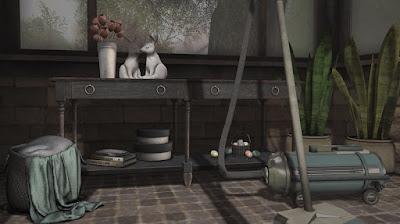
photo courtesy of M I R A on Flickr
Before I get started with this piece, I’d like to reiterate something that I think is extremely important. What you are about to read, listen to, or otherwise take in is my opinion on the subject based on my experiences, practice, and mentality. If you are looking for the absolutely, undeniably, no argument can be made, correct answer, I suggest you stop with this piece and go find another. There are many folks out there who will tell you that theirs is that answer, but I’m not one of them. I feel like this point needs to be clearly understood because ultimately there are no absolutely correct answers and what really matters is what you understand for yourself. With all that said, here’s my opinion on the topic of samu.
The term samu is often translated as “work practice”. Wikipedia has a very short article that says samu is “participation in the physical work needed to maintain the Zen monastery.” The idea of “work practice” as many use it is something along these lines. Work done to help the zendo or practice space. From where I sit, that’s an interesting definition but only hits on a really small part of the issue. Let me posit a better definition, “work AS practice”. This may seem like a really simple change, but it points to the intention that you hold while doing the work rather than what it is specifically that you are doing. From here, we have a much wider landscape of work that can fall into the term samu. Just for the sake of clarity, if the schedule during sesshin says samu, it is almost certainly pointing to the first definition, but outside of that context, the second definition is more useful.
So what is the intention that I’m talking about? To answer this, we need only look to our zazen practice as a guide. When we sit, we just sit. We don’t make grocery lists. We don’t visualize our spirit animals. We just sit. When we bring this single-minded focus from the cushion to our work, we can then call it samu, work as practice. Now this is much easier to do when the task to be done is relatively simple, which is why Zen centers tend to assign chores like polishing the Buddha (which just sounds weird), sweeping the floor, or scrubbing the toilet. These basic mostly physical tasks allow us to just do the work and let the mind be on the work until we become one with the task. This doesn’t mean it is impossible to do with more complex undertakings like office work, paying bills, or writing dharma talks. It’s just harder to establish and maintain our focus. Also, it’s worth pointing out that, just like zazen, we set out intention to work solely on the task at hand and then get distracted. This is not a problem. Just like zazen, when we notice that we have become distracted, we bring ourselves back to our task, over and over again until either the task is done or the period of samu ends.
After saying all this, I want to address two other points that often come up during the discussion of work and Buddhist practice. The first is what kinds of work can or should a Buddhist do. If you read what I said in the last paragraph and take it by itself outside of the envelope of the rest of Zen and Buddhism, you might come to the conclusion that a hitman could be doing samu when he kills someone so long as he maintains the proper focus on just killing. In fact, this argument pops up from time to time when folks want to argue about the dangers of mindfulness. We can teach mindfulness to soldiers and it will make them better killers. As I said a few sentences ago, to get to this point, you have to take what I said and remove it completely from the rest of Buddhism. Why? Because the first dang precept in Zen is Protect Life, Do Not Kill. To put it in more general terms, the Buddha was focused on the end of suffering and he created the Noble Eightfold Path as a way of living that supports the quest for the end of suffering and Right Livelihood is one of those folds. To put it yet another way using my favorite dirty glass metaphor, our practice is about letting the dirt in our glass settle so that we can see clearly. Killing and other such activities, no matter the mindset with which they are undertaken, have a tendency to add a lot of dirt to the glass and severely stir things up regardless of the reason. There’s an entire discussion to have regarding killing and precepts and whatnot which is not the subject of this piece so let’s move on for the moment.
The second point that I want to talk about is one that’s a little less controversial, but still seems to come up from time to time and that’s the subject of money. Dana is one of the perfections found in Buddhism. It is most often interpreted as “free giving” and is the subject of numerous books. What counts as free giving? What doesn’t? Often, folks want to tie the idea of dana to the idea of samu. I would argue that the two go hand-in-hand a lot, but be can’t inextricably linked and shouldn’t be. When we work to maintain our practice space, this form of samu is done with no thought of reward and therefore qualifies as dana under most strict definitions. But, when you really think about it, are you really working for free or is your payment for the work just non-monetary? Is the teacher freely giving a talk and are you freely giving your work? It’s an interesting question to ponder. And just to make things a little more confusing, our good buddy Dogen says in the Shobogenzo fascicle Four Elements of a Bodhisattva’s Social Relations that “earning a living and doing productive work are originally nothing other than free giving.” But we’re wandering away from the point a little here. The original discussion wasn’t about dana at all, but about samu, work as practice. Any work activity, done as a form of Zen practice, i.e., with single-minded focus and intention, can be a form of samu. Saying that you can’t get paid for it is just tacking on something that in my opinion wasn’t really part of the discussion to begin with. Now can it be called dana when you’re getting paid for it? That’s a different discussion.
To try and sum all this up, we spend a tremendous amount of time during our lives working in one form or another. Whether it is work for an employer or work to maintain our lifestyles, we are almost constantly working on something. I encourage all of us to use this time not only to make money and better our external situation, but also as an opportunity for practice. When we do what needs to be done, with focus and attention, our work becomes part of our practice and a much richer experience.
Gassho,
Daishin


